Play · Growth · Human Flourishing. Powered by AI
Moses Silbiger, MA
Researcher · AI + Play + Interactive Systems >> Catalyzing Growth
Researcher Context & Background

Research Orientation
Moses Silbiger, MA
Tech-Mediated Developmental Systems Strategist & Researcher

• Research focused on formalizing developmental psychology into structured systems frameworks.
• Exploration of translational pathways into interactive, adaptive, and playful environments.
• Orientation toward catalyzing growth across multiple intelligences.
Field experience includes press coverage of the Game Developers Conference - GDC (2007-2008) and SXSW 2011,
for the Brazilian magazine Digital Designer (UOL), along with continued attendance at SXSW (2023–2026)
as an independent researcher, including recent years where AI has become a central focus.
Academic Foundation
• Bachelor of Architecture - Federal University of Minas Gerais (UFMG), Brazil
• MA in Integral Psychology - John F. Kennedy University (JFKU)
• Graduate Certification in Professional Coaching - JFKU Graduate School of Psychology
• Authorized Practitioner, Leadership Maturity Framework (Harvard-originated developmental assessment)
From Architecture to Developmental Systems
My professional foundation began in architecture, coupled with 3D digital visualization, and digital design -
disciplines operating at the intersection of structure, perception, and function.Unlike purely expressive visual arts, architecture must do more than appear coherent. It must function under gravity,
material constraints, budget realities, regulatory limits, and human behavior.
It requires balancing aesthetics with structural logic and usability.Likewise, 3D visualization and digital design involve modeling complex systems, simulating environments,
anticipating user interaction, and translating abstract concepts into coherent visual experiences.
Across these disciplines, the core skill remains consistent:
Designing systems that are structurally sound and experientially meaningful.
Over time, a parallel interest matured alongside this design practice: human development.
What began as personal inquiry during my architectural studies gradually evolved into formal academic pursuit.
I pursued a Master’s degree in Integral Psychology as a natural extension of this systems-oriented lens -
expanding from physical systems into developmental systems.
The same questions remained similar, but applied at different scales and dimensions:
• How could strategically designed structures catalyze integration & growth?• How could design of interactive & adaptive environments shape possibility?
Where architecture organizes space, developmental psychology integrates experience.
My academic training integrated developmental psychology, systems thinking, and contemplative traditions.
My focus, however, remained structural and applied.Development unfolds cognitively, emotionally, relationally, ethically, behaviorally, culturally, systemically - and existentially.
It is not linear, singular, or uniform.The foundational insights were articulated by major developmental thinkers, among others, such as:
Piaget, Maslow, Gardner, Graves, Cook-Greuter, Vygotsky, Wilber.
My contribution is directional:
How to translate these insights into structured, playful, interactive systems.

“Developmental architecture refers to the intentional design of interactive systems that calibrate challenge
to capacity, embedding growth directly into experience rather than treating it as external instruction.”
Master’s Final Project, Integral Psychology (2008) - Moses Silbiger
Academic Recognition & Publication
The research underlying this framework was formally published and recognized within academic venues:• Published in **Journal of Integral Theory and Practice, SUNY Press, Volume 5, Issue 2, pp. 117-148 (2010)
Article: Press Play to Grow! Designing Video Games as “Trojan Horses” to Catalyze and Integrate Human Development,
pages 117-148.
Published in a peer-reviewed academic journal (SUNY Press, 2010 - Vol. 5, No. 2). View publication details below.

Master’s Final Project (Integral Psychology, JFK University, 2008).
Original research manuscript on which the later Journal of Integral Theory and Practice publication was based.
Open-access archival copy available.

“Video games can function as 'Trojan Horses' for developmental growth,
embedding structured transformation within engaging interactive systems.”
Journal of Integral Theory and Practice (JITP, SUNY Press), 2010 - Moses Silbiger
• Two Honorable Mentions – Integral Theory Conference (2008)
• Honorable Mention – Integral Theory Conference (2010)• Research presented at:• Game Learning Society (G+L+S), University of Wisconsin–Madison (2008)
• Meaningful Play Conference, University of Michigan (2008)
• Integral Theory Conference, John F. Kennedy University (2008, 2010)
The research framework originated in the Master’s Final Project (2008), was presented at academic conferences,
and was subsequently published in 2010 in the Journal of Integral Theory and Practice (SUNY Press).

Academic Journal Cover
During my graduate research, I began formalizing what I call developmental architecture -
the design of interactive environments that catalyze and adapt to human growth..
Developmental Architecture
My work drew from developmental psychology, systems thinking, and applied research in adult development,
including models associated with Vygotsky, Csikszentmihalyi, Gardner, Cook-Greuter, and Wilber.
These frameworks converge on a central insight:
Growth accelerates when challenge is precisely calibrated to capacity.
In practical terms, this means environments can be designed to:• Align difficulty with skill level• Provide structured feedback loops• Sustain engagement at the edge of competence• Support cognitive, emotional, ethical, somatic, and relational development
I explored how interactive systems could dynamically align challenge with capacity.
Rather than forcing growth, a system can:• Detect behavioral and cognitive patterns• Adjust challenge in real time• Scaffold progression across developmental levels and multiple lines of intelligence• Integrate internal and external dimensions of growth
Rather than treating development as abstract theory, I approached it architecturally -
asking how these developmental insights could be embedded into designed systems.The goal was not conceptual commentary. It was implementation.
At the time, implementing this architecture dynamically required
technological responsiveness that did not yet exist at scale.
Today, AI systems can.
Applied Experiments & Hibernation Period
Between 2010 and 2024, I developed several applied initiatives translating developmental psychology
into operational interactive systems.These initiatives include two applied simulation architecture efforts - CODE S.U.S. (2010) and METASIMZ (2024)
alongside METAUREUS (2022–2025), an AI/XR studio infrastructure supporting immersive simulation development.In parallel, an awarded storyboard later produced as Episode 3 of the BAR KARMA TV series (Current TV, 2011)
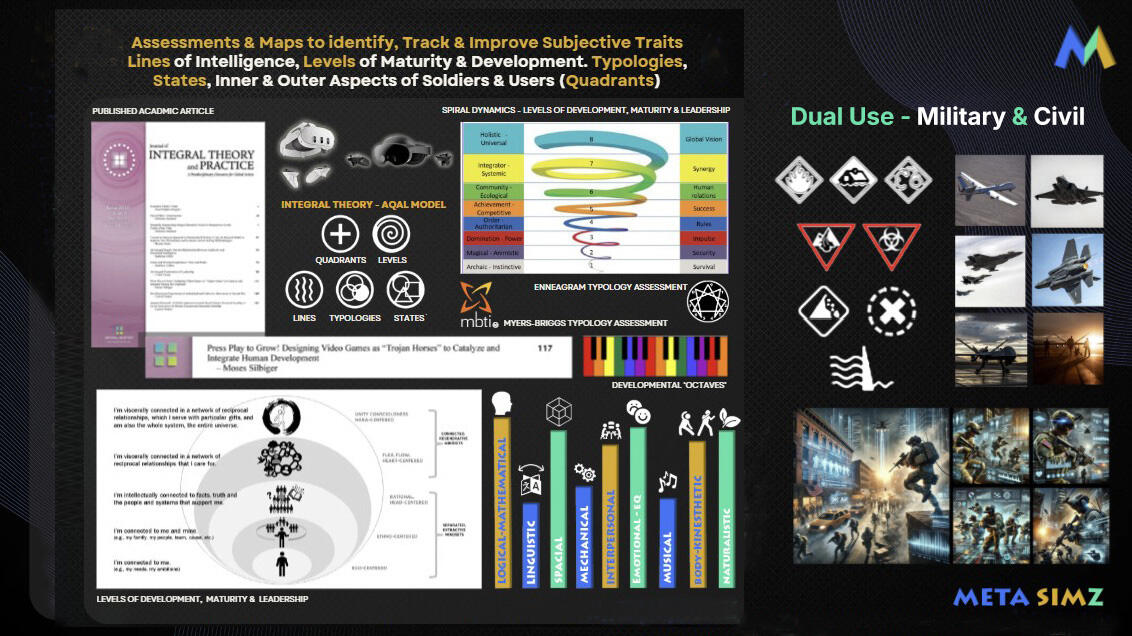
represented a participatory media contribution embedding developmental themes within a crowdsourced television experiment.Most recently, this work informed a dual-use (military + civilian scalable) simulation proposal for the DoD/U.S. Air Force, METASIMZ (2024) - integrating
immersive technology with adaptive psychological-state modeling and human performance assessment.
1. METASIMZ - XR Training Simulation Proposal for U.S. Dept. of Defense (DoD) - U.S. Air Force (2024)]{#eec644}
An immersive training simulation grant proposal integrating extended reality (XR – VR/AR), LiDAR-enabled spatial modeling,
adaptive systems architecture, and a game-structured performance framework.The concept proposed a dual-use simulation architecture initially focused on U.S. Air Force tactical readiness,
resilience training, and complex operational scenario modeling.A central innovation was the integration of psychological resilience systems — including PTSD response patterns,
emotional regulation challenges, stress adaptation modeling, and multi-line developmental intelligence
(intellectual, emotional, somatic, and kinesthetic).The architecture was intentionally designed to evolve from military deployment into scalable civilian and commercial applications
in subsequent phases - including emergency response training (fire, ambulance, disaster services), law enforcement
and self-defense simulations, and eventually adaptive AR/XR and game-based platforms for broader public and entertainment use.Through my company Metaureus (AI, XR, 3D Studio), I assembled a multidisciplinary XR/AI team and structured the MetaSims concept
into a formal U.S. Department of Defense (DoD) - U.S. Air Force grant submission.While the proposal did not advance into funded development due to structural funding constraints and cycle competitiveness,
the conceptual architecture was fully articulated and remains extensible.
PROPOSAL SAMPLE - METASIMZ
U.S. DEPARTMENT OF DEFENSE – U.S. AIR FORCE
2. METAUREUS - XR, AI & 3D Systems Studio (2022–Present)
Metaureus was established as a studio integrating extended reality, artificial intelligence, and 3D simulation technologies
within a unified creative and technical environment.It represented an applied extension of the developmental architecture explored in earlier conceptual projects.
While independent of the METASIMZ/DoD proposal, METAUREUS later served as the organizational platform
through which the METASIMZ simulation concept was formally conceived.As a studio, it reflected the practical convergence of immersive media & adaptive systems required to move from theoretical design
toward operational experimentation.


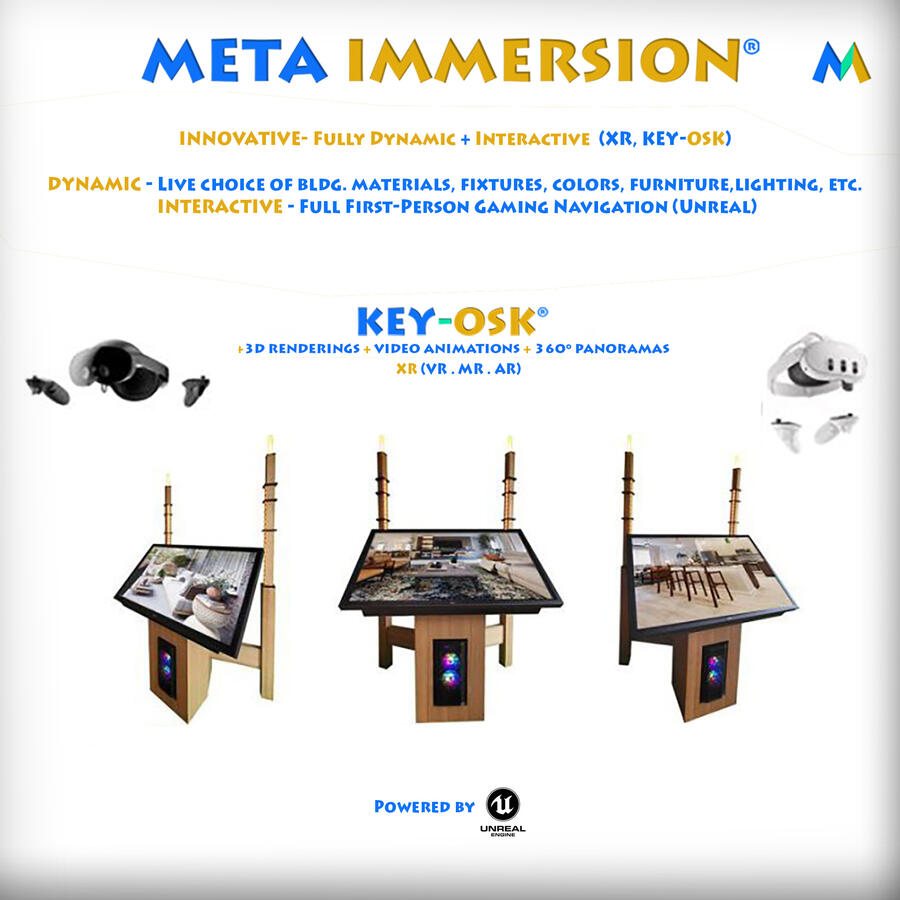
META 3D - 3D RENDERING & ANIMATIONS
META 360° - DYNAMIC & INTERACTIVE PANORAMA
META IMMERSION - GAMING UX
3. CODE S.U.S. - Human Systems & Environmental Strategy Game Prototype (2010)
Code S.U.S. was an early attempt to translate developmental psychology and integral systems theory into interactive game mechanics
within an environmental sustainability context.The concept explored how psychological growth models could inform player progression, ethical decision-making, and multi-level
environmental strategy.Following academic research integrating developmental psychology and digital systems, I initiated a conceptual game framework
designed to operationalize developmental models within interactive environments.The project was presented as a poster at the Integral Theory Conference (ITC, 2010), outlining an early-stage game architecture
derived from this research.Advisors and collaborators included figures from the Entertainment Technology Center at Carnegie Mellon University (ETC),
the Electronic Arts Game Innovation Lab at the University of Southern California, Georgia Tech University, and senior researchers
and consultants within the Integral community, including Ken Wilber and associated developmental scholars.Conceptual development of the framework included collaboration with Russel DeMaria, a veteran game designer and author
of over sixty books on video game design and interactive media.The initiative remained at the exploratory framework stage and was not developed into a finished prototype.Further development entered a period of hibernation during the prototype and investor preparation phase.
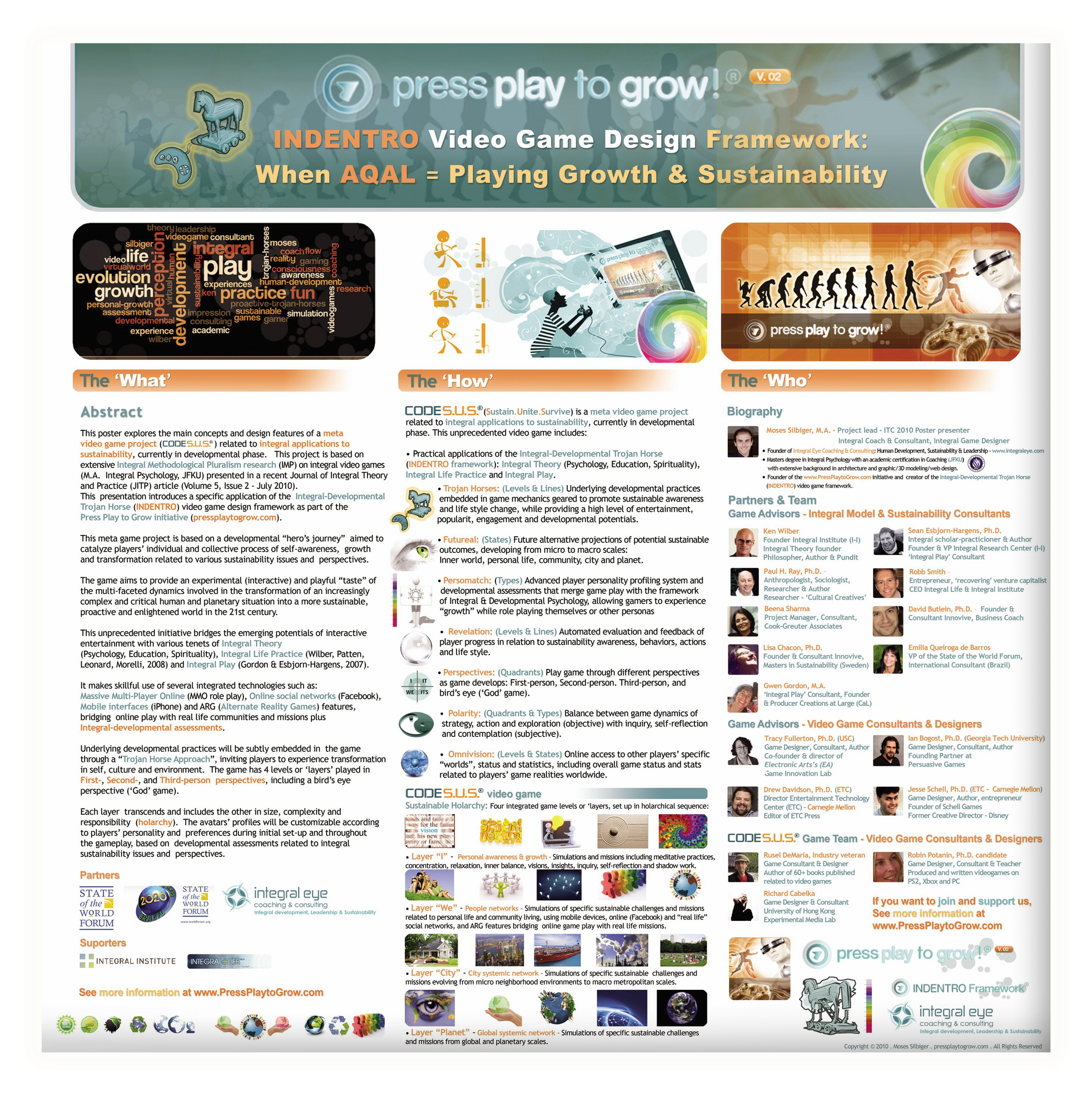
View Systems-Based Sustainability Game Prototype - CODE S.U.S
ITC 2010 - Honorable Mention
3. "Bar Karma” TV Series - Participatory Television Experiment (Current TV, 2011)
Award-Winning Story Contributor to the Crowdsourced Story Development Process
Early participatory television initiative created by renowned game designer Will Wright (SimCity, The Sims, Spore),
exploring crowdsourced storytelling through interactive media platforms.
Media coverage and industry documentation include:
Feature coverage of the Bar Karma crowdsourced storytelling experiment.
Industry release confirming Episode 3 submitted by Moses Silbiger.
Coverage of Will Wright’s expansion into participatory television through Bar Karma on Current TV.
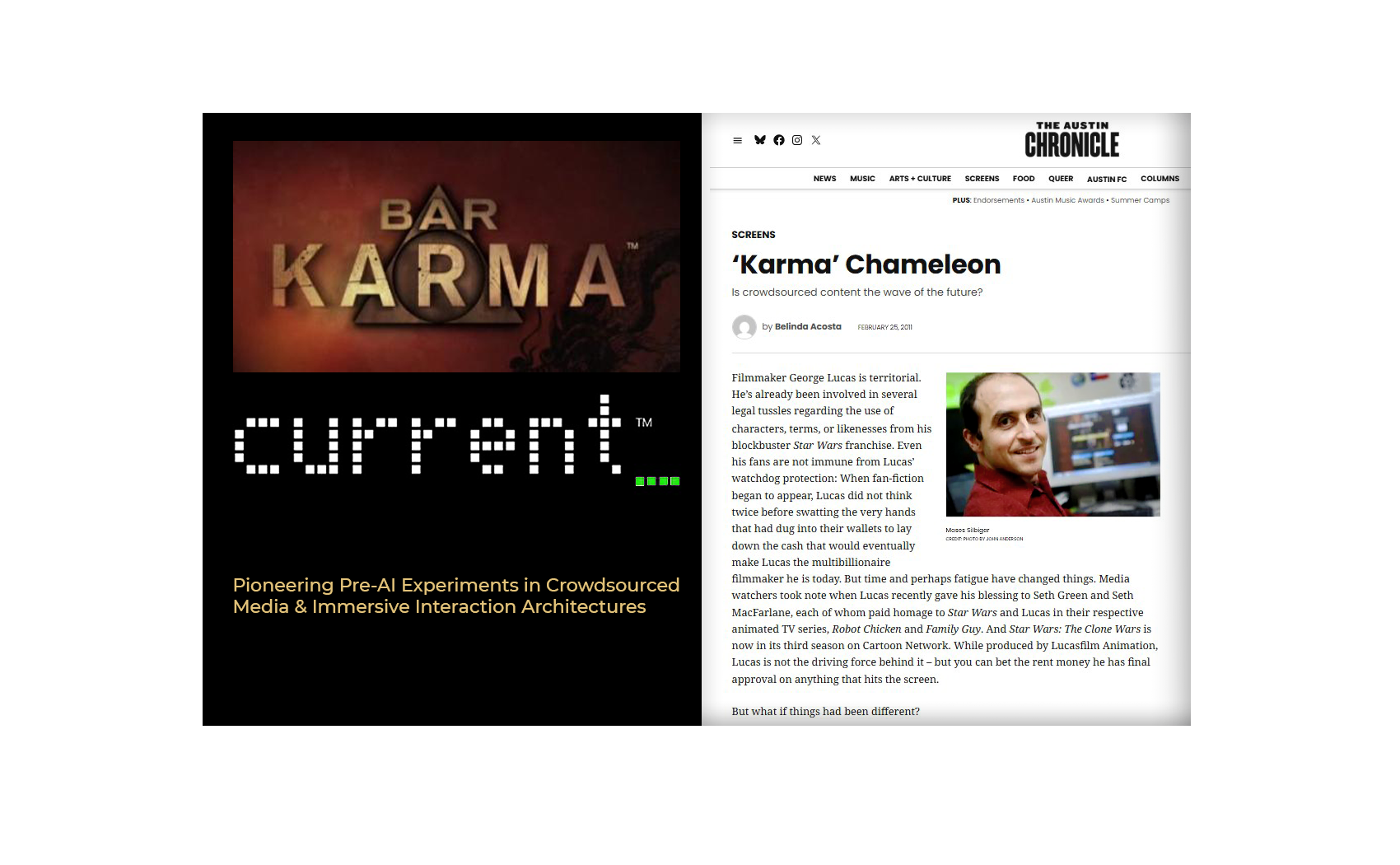
VIEW AWARD-WINNING CROWDSOURCED CONCEPT – BAR KARMA - CURRENT TV
Austin Chronicle feature article - Ep.3: An Open Mind
Synthesis of Applied Experiments
Each of these three applied initiatives reinforced the same principle: the architecture was conceptually viable, but technological,
institutional, or contextual realities limited full execution.
The architecture was ahead of its time.
The enabling technologies were not yet mature, and the necessary conditions had not yet converged.
Today, they have.
AI makes that convergence operational.
Continuity
The core architecture has remained consistent.
What has changed is the surrounding technological ecosystem.
Adaptive AI systems, behavioral modeling, machine learning, real-time feedback loops,
and XR platforms now make technically feasible what was previously conceptual.
Site Architecture
You are here ▾
▶PAGE 2-Researcher Context & Background
• Research Lens: Gameplay & Interactivity as 'Trojan Horses' for Growth
Explore
• Explore the Research

• From Research to Application

• From Foundation to Future


© 2026 Press Play to Grow! All rights reserved.